
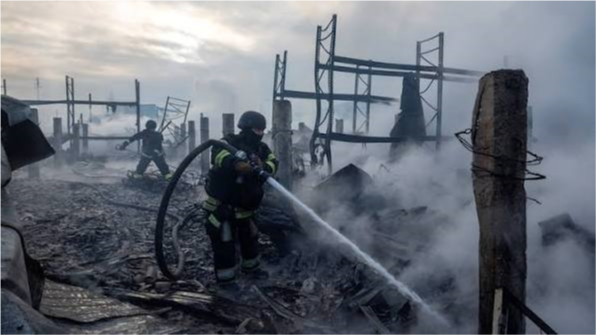
Ukraine is facing another difficult period in its ongoing war with Russia following a major wave of drone and missile attacks targeting different parts of the country. The latest developments have increased concerns about civilian safety, the destruction of important infrastructure and the possibility of a humanitarian crisis as winter approaches. Russian attacks have continued to place pressure on Ukraine’s military resources, electricity supply and emergency response services.
Rescuers work at the site of a house that was destroyed in Lapaivka, near Lviv
On 18 November 2026, Ukrainian President Volodymyr Zelenskyy reported that Russia had launched approximately 597 attack drones and 26 cruise missiles during an overnight assault. Ukrainian air defence forces managed to intercept more than 20 missiles and most of the drones. However, the scale of the attack demonstrated that Russia continues to possess considerable military capabilities and remains committed to maintaining pressure on Ukrainian territory.
The latest assault has also renewed calls from the Ukrainian government for stronger international military assistance, particularly advanced air defence systems and equipment capable of intercepting incoming drones and missiles.
Details of the Russian Attacks
According to reports from Ukrainian authorities, the overnight assault involved hundreds of drones and several missiles directed towards different Ukrainian targets. The scale of the operation made it one of the most significant aerial attacks reported during the conflict.
Ukraine’s air defence system played an important role in preventing further destruction. Military units used available defensive equipment to detect and intercept incoming threats. Nevertheless, the large number of weapons involved demonstrated the challenges Ukraine faces when defending its territory against repeated and coordinated aerial attacks.
President Zelenskyy condemned the attacks and called on international partners to strengthen Ukraine’s defensive capabilities. He argued that the country needs more modern air defence systems and increased investment in interceptor drones to protect its cities and infrastructure.
The attacks are part of a wider pattern of Russian military operations that have increasingly placed pressure on Ukrainian cities, transportation networks and energy facilities.
Impact on Civilians and Essential Infrastructure
One of the greatest concerns arising from the latest attacks is their impact on ordinary citizens. Military operations involving missiles and drones create serious risks for people living in urban areas, particularly when residential neighbourhoods and essential infrastructure are affected.
Families may be forced to spend long periods in underground shelters, while schools, hospitals and businesses can experience interruptions to their normal activities. People living near damaged infrastructure may also face difficulties accessing electricity, heating, water and medical services.
As winter approaches, these problems become particularly serious. Low temperatures increase the need for reliable heating and electricity. Damage to energy facilities could leave households vulnerable and place additional pressure on emergency services.
Ukrainian authorities have therefore continued preparations to protect energy infrastructure, repair damaged facilities and ensure that essential services remain available during the cold season.
The humanitarian consequences of repeated attacks extend beyond physical injuries and property destruction. Many civilians experience fear, uncertainty and psychological stress because they do not know when another attack may occur.
Children and elderly people are particularly vulnerable because they may have limited ability to respond quickly to emergencies or relocate to safer areas.
Ukraine Requests More International Military Assistance
The Ukrainian government has repeatedly appealed to Western countries for additional military assistance. Its main priority is strengthening air defence capabilities to prevent Russian missiles and drones from reaching important targets.
The United States and European countries have provided Ukraine with different forms of military support since Russia launched its full-scale invasion in February 2022. This assistance has included air defence equipment, ammunition, military training, financial support and intelligence cooperation.
However, the increasing scale of Russian aerial attacks has created additional demands on Ukraine’s defensive resources.
“Ukraine is facing another difficult period in its ongoing war with Russia following a major wave of drone…”
President Zelenskyy has argued that international partners must continue supporting Ukraine because its ability to defend itself is closely connected to European security.
European governments have also expressed concern about the continuing attacks. They have discussed additional assistance, including military equipment, financial support and measures intended to increase pressure on Russia.
The challenge for Ukraine’s partners is balancing continued support with their own economic and political priorities.
Economic Consequences of the Attacks
The destruction of infrastructure has serious economic consequences for Ukraine. Energy facilities, transport networks, factories and commercial buildings are essential to the functioning of the country’s economy.
When these facilities are damaged, businesses may be forced to reduce production or temporarily close. This can result in unemployment, lower household incomes and reduced government revenue.
The cost of repairing damaged infrastructure is also significant. Government resources that could otherwise support education, healthcare and development projects must be redirected towards reconstruction and emergency assistance.
International financial support therefore remains important for maintaining Ukraine’s economic stability.
The war has also affected foreign investment. Businesses may hesitate to establish operations in areas where military attacks remain frequent. This makes economic recovery more difficult and increases Ukraine’s dependence on international financial assistance.
International Security Implications
The latest attacks have implications beyond Ukraine’s borders. The conflict has become a major concern for European security because continued military escalation could increase tensions between Russia and Western countries.
European governments are particularly concerned about the possibility that the conflict could expand or create additional security challenges for neighbouring states.
The attacks also demonstrate the growing importance of drone technology in modern warfare. Both sides have increasingly relied on unmanned aerial systems for surveillance and military operations.
This development has encouraged countries around the world to reconsider their defence strategies and invest more heavily in air defence technology.
Conclusion
The latest Russian drone and missile attacks demonstrate that the war in Ukraine remains dangerous and unpredictable. Despite Ukraine’s efforts to strengthen its air defence systems, the country continues to face serious military and humanitarian challenges.
The approaching winter makes the situation even more concerning because damage to electricity and heating infrastructure could affect millions of civilians.
International military and financial assistance will remain essential for helping Ukraine protect its population and maintain its national infrastructure. At the same time, diplomatic efforts must continue to prevent further escalation.
Ultimately, the situation demonstrates that the war cannot be understood only as a military confrontation. It is also a humanitarian, economic and international security crisis that requires sustained international attention and a long-term commitment to peace.