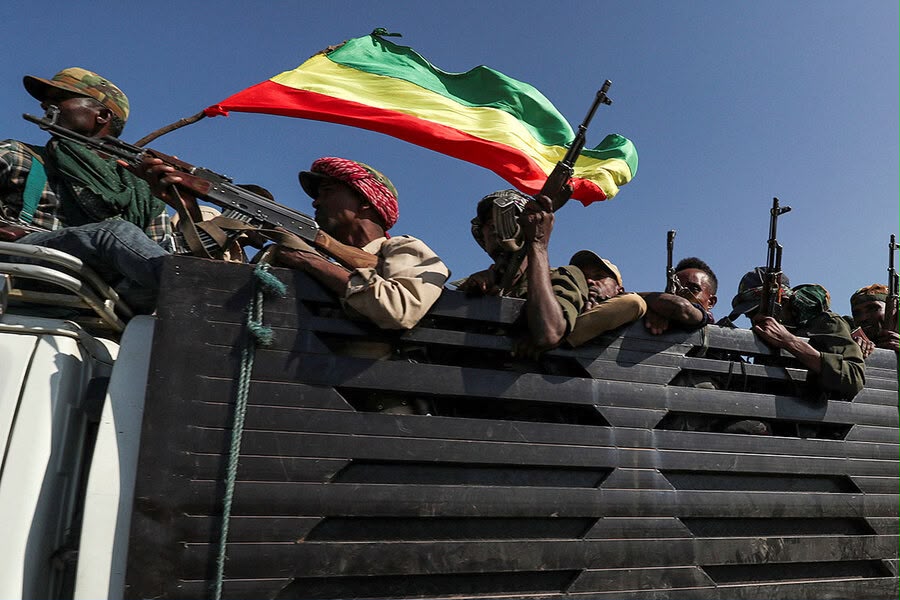
Ethiopia’s renewed fighting is pushing one of Africa’s most strategically important countries back toward a dangerous period of instability, with clashes in the north raising fears that a domestic conflict could develop into a wider regional crisis.
Government forces and Tigrayan fighters have been involved in renewed hostilities after years of fragile calm following the devastating Tigray war. Recent fighting has intensified around strategic areas, with reports of federal forces advancing and government forces claiming control of important positions.
The latest escalation has reopened deep political and military divisions that were never completely resolved by the peace agreement that ended the previous war.
The danger extends far beyond the battlefield.
Ethiopia is one of the Horn of Africa’s largest and most influential countries. Its stability affects neighbouring states, regional trade routes and humanitarian operations across a part of the continent already struggling with multiple security crises.
The renewed violence is particularly concerning because Ethiopia shares borders with Eritrea, Sudan, South Sudan, Kenya, Somalia and Djibouti. Several of those countries are already dealing with political instability, armed conflict or severe humanitarian pressures.
Any major deterioration inside Ethiopia could therefore create new pressure across the region.
The humanitarian consequences are also becoming increasingly serious. Previous fighting in Tigray caused enormous civilian suffering, displacement and disruption to essential services. Renewed hostilities threaten to reopen those wounds and create another wave of people requiring emergency assistance.
Transport and supply routes are another major concern.
Ethiopia relies heavily on Djibouti for access to international trade because it is landlocked. Instability affecting routes through the Afar region could create additional pressure on the movement of food, fuel and commercial goods.
The conflict is also unfolding against a complicated regional backdrop.
“The renewed fighting is reopening a dangerous fault line in a region where instability can quickly cross national…”
Sudan remains trapped in a devastating war, while Somalia continues to face security challenges involving militant groups. At the same time, relations between Ethiopia and Eritrea remain highly sensitive because of their shared history and previous confrontation.
That combination makes the latest Ethiopian escalation particularly dangerous.
A prolonged conflict could consume government resources, deepen political divisions and create additional humanitarian demands at a time when international aid systems are already under enormous pressure.
For ordinary Ethiopians, the immediate concern is not regional geopolitics but security, food, access to healthcare and the ability to live without fear of renewed war.
The international community will therefore be watching developments closely.
The central challenge for Ethiopia is preventing the latest violence from becoming another prolonged conflict. That will require political engagement alongside efforts to prevent further military escalation.
The latest developments demonstrate how quickly unresolved tensions can return to the centre of national politics.
Ethiopia’s previous war showed the devastating price of prolonged conflict. The renewed fighting has once again placed that warning at the heart of the Horn of Africa.