
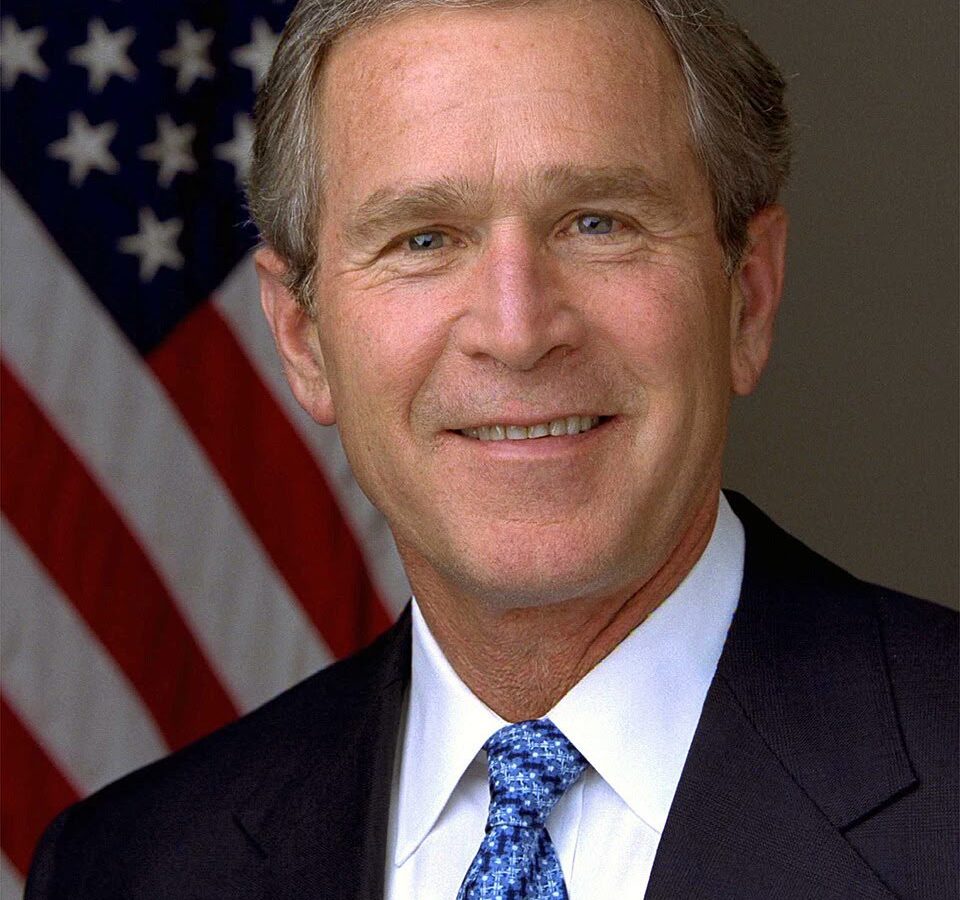
More than fifteen years after walking out of the Oval Office with some of the lowest public approval ratings in modern political history, George W. Bush is once again at the center of the American cultural zeitgeist. For years, the 43rd president maintained a relatively quiet post-presidency at his ranch in Crawford, Texas, choosing to focus on private hobbies and institutional charity rather than the volatile mudslinging of modern cable news. However, a major breaking announcement, combined with shifting partisan dynamics and a growing sense of historical nostalgia, has sent his name skyrocketing back to the top of active internet search trends.
The re-emergence of George W. Bush is not a mere coincidence; it is the result of a calculated pivot into human rights activism, an enigmatic stance on the current state of the Republican Party, and a profound national curiosity regarding a past political era. To understand why “43” is suddenly generating massive traffic online, one must examine the intersection of his controversial new art project, his tactical silence in an election year, and the surprising ways history is rewriting his policy legacies.
The 2026 Breakthrough: Art, Huma
n Rights, and Accusations of Irony
The immediate driver of internet buzz surrounding the former president is his newly announced book and public art exhibition. In mid-September 2026, the Penguin Random House imprint, Crown, announced that Bush will publish a new collection of oil paintings titled The Call of Freedom: Portraits of Political Prisoners and Dissidents. Scheduled for release on March 9, 2027, alongside a companion exhibit at the George W. Bush Presidential Center in Dallas, the book will feature 44 full-color portraits of men and women from across the globe who have faced severe persecution for fighting for human rights.
Among the high-profile subjects Bush has painted are the late Iranian activist Mahsa Amini, whose 2022 death sparked worldwide protests against systemic oppression, and imprisoned Nicaraguan bishop Rolando José Álvarez Lagos. Former Soviet Union dissident Natan Sharansky is even contributing a foreword to the volume. In an official statement, Bush noted that the project is intended to send a distinct message that the United States deeply cares about people seeking liberty, reminding citizens that “we who live in liberty have a duty to stand with those who do not.”
While the book is already climbing pre-order charts, it has also reignited a fierce, high-traffic debate across social media channels like X (formerly Twitter) and Instagram. Digital commentators have quickly pointed out the deep ideological paradox at play: a president whose administration authorized controversial CIA “enhanced interrogation techniques” like waterboarding and oversaw the severe human rights scandals of Abu Ghraib prison is now positioning himself as a primary global chronicler of political prisoners. This polarizing clash—between the stark realities of the post-9/11 War on Terror and Bush’s late-stage humanitarian art—is precisely the kind of content that drives thousands of daily clicks, as both defenders and detractors clash over his true motivations.
The Enigma of Silence: Bush and the Modern GOP
Beyond the art world, Bush remains an object of intense political curiosity due to what he chooses not to say. As the Republican Party underwent a massive populist transformation over the last decade, the traditional, neoconservative establishment represented by the Bush family was largely pushed to the margins. Despite numerous public taunts from populist leaders who explicitly targeted the Bush family’s legacy, the former president has steadfastly refused to break his silence or publicly endorse a side in recent high-stakes presidential cycles.
Political analysts note that Bush’s strategy of total detachment is intentional. By avoiding the day-to-day political fray, he protects his presidential library and institute from becoming hyper-partisan targets. Yet, this strategic omission keeps voters and political junkies endlessly intrigued. Every time a new election cycle peaks, search queries for “George W. Bush endorsement” surge. Audiences from both sides of the aisle are desperate to know whether the last living two-term Republican president prior to the modern era will ever break his isolation to weigh in on the soul of his party. His continued silence acts as a blank canvas upon which commentators continuously paint their own theories, ensuring a steady stream of political traffic.
The PEPFAR Phenomenon: How History is Rewriting the Legacy
“For years, the 43rd president maintained a relatively quiet post-presidency at his ranch in Crawford.”
While many associate the Bush presidency primarily with the polarizing, long-tail financial and human costs of the wars in Iraq and Afghanistan, or the devastating economic fallout of the 2008 Great Recession, a quieter historical re-evaluation is occurring online. Generation Z and millennial researchers are increasingly discovering the massive scale of Bush’s international humanitarian programs, most notably the President’s Emergency Plan for AIDS Relief (PEPFAR).
Launched by Bush in 2003, PEPFAR is widely considered by public health scholars to be the single most successful global health initiative in human history. To date, the program has transformed global health infrastructure and saved an estimated 25 million lives, primarily across Sub-Saharan Africa, by providing widespread access to life-saving antiretroviral medications. Alongside the President’s Malaria Initiative, which significantly reduced malaria mortality rates globally, these humanitarian investments represent an entirely different side of the 43rd president. As modern foreign policy debates increasingly turn toward isolationism, articles highlighting the tangible, life-saving triumphs of the Bush-era internationalist approach are capturing significant long-tail SEO traffic from readers looking for bipartisan historical truths.
Viral Nostalgia and Unlikely Friendships
Finally, no analysis of George W. Bush’s current traffic pull would be complete without acknowledging his status as an accidental pop-culture icon. In an era defined by deep political polarization and hostile rhetoric, audiences are oddly comforted by the viral, cross-party friendships of the past. The most famous example is the enduring, genuine bond between George W. Bush and former First Lady Michelle Obama.
Images of Bush playfully passing Altoid mints to Obama during formal events—such as the funeral of Senator John McCain or the inauguration of subsequent presidents—frequently resurface as wholesome, highly shareable memes. These small, humanizing moments cut through political cynicism and fuel a nostalgic longing for a time when leaders of starkly opposing parties could share mutual respect and affection. For lifestyle blogs and social media managers, these lighthearted human-interest angles offer guaranteed engagement, providing a stark, comforting contrast to the intense ideological battles of the modern day.
Conclusion
Ultimately, George W. Bush remains an endlessly fascinating figure because his legacy refuses to be neatly categorized. He is simultaneously the wartime commander-in-chief who launched the highly controversial global War on Terror and the sensitive painter who dedicates his retirement to honoring global dissidents. He is the fiscal conservative who presided over the anxieties of the Great Recession, yet also the sweeping humanitarian who saved millions of lives from the global AIDS crisis.
As his new book The Call of Freedom prepares to take center stage in early 2027, the public’s obsession with unpacking these contradictions guarantees that George W. Bush will remain a primary driver of digital traffic for a long time to come. Whether driven by political debate, historical curiosity, or simple internet nostalgia, the world is still trying to understand the full scope of America’s 43rd president.